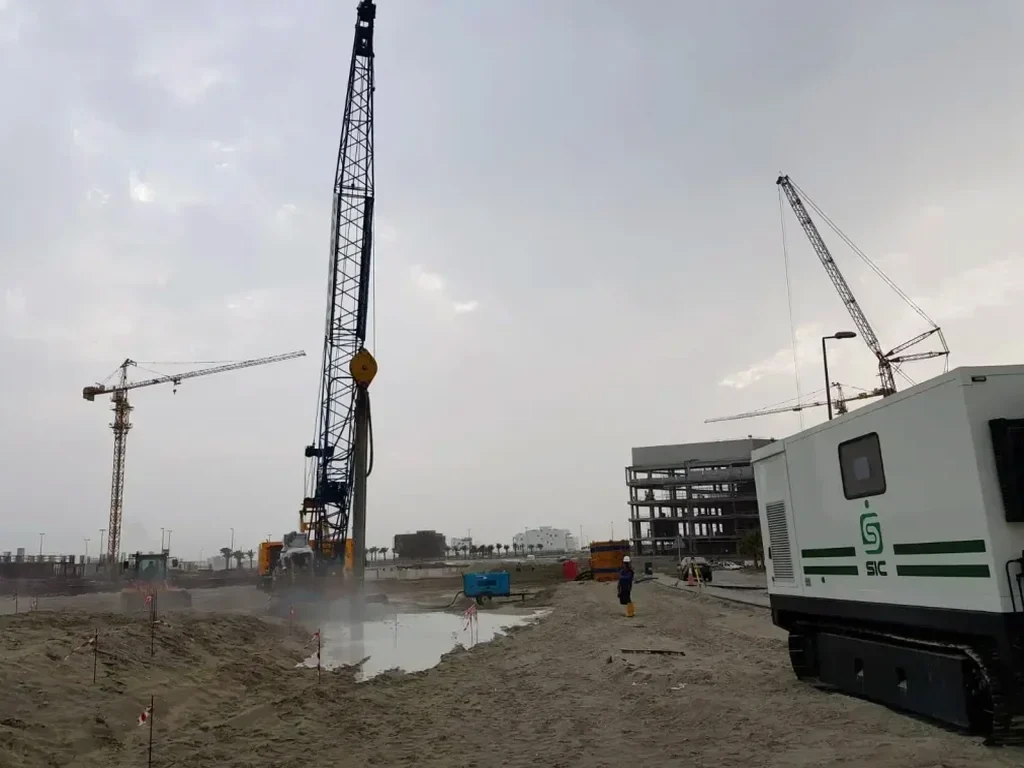
A commercial development on Sherbrooke’s Portland Boulevard ran into unexpected loose fill that extended deeper than the exploratory boreholes had indicated. The general contractor needed a densification method that would not require excavation and replacement, given the proximity of adjacent structures and the high seasonal water table common in the Saint-François River valley. We designed a vibrocompaction grid using electric depth vibrators, specifying probe spacing, treatment depth, and hold time based on the grain-size distribution of the native sand and gravel. In Sherbrooke, where glaciolacustrine deposits and post-glacial alluvium often coexist, identifying truly granular zones is the first critical step — otherwise, vibratory energy dissipates without effective compaction. That is why the design phase integrates closely with field verification, and we frequently combine the treatment plan with a CPT test program to map pre-treatment tip resistance and confirm improvement after each pass. The approach saves time compared to over-excavation and provides a uniform bearing stratum for shallow footings.
A vibrocompaction design is only as good as the grain-size data that supports it — misclassifying a silty sand as clean sand will lead to failed treatment.
Local ground factors
The contrast between Sherbrooke’s east and west sectors illustrates the risk of a one-size-fits-all design. Near the Université de Sherbrooke campus, soils are predominantly glacial till with abundant coarse fraction — vibrocompaction works efficiently, and designs can rely on standard energy input. Westward toward Lennoxville, the Saint-François floodplain introduces thicker sequences of silty sand and organic silt layers that are invisible without a proper test pits investigation. If vibrocompaction is specified in those silty zones, the result is surface heave without density gain, and a contractor facing costly change orders. The design process must therefore include a thorough site characterization phase: borehole logs, grain-size curves, and groundwater monitoring. We also evaluate the risk of vibration-induced settlement in nearby structures, a concern in Sherbrooke’s older masonry buildings along Rue King. A well-prepared design package anticipates these variables and defines contingency triggers — such as switching to stone columns if fines exceed 20%.
Q&A
What is the typical cost range for vibrocompaction design in Sherbrooke?
The design phase, including feasibility analysis, laboratory testing, and preparation of the treatment plan, generally falls between CA$1,740 and CA$8,040 depending on the size of the site and the complexity of the soil profile. This does not include the execution of the vibrocompaction itself or the verification testing, which are quoted separately.
How do you verify that vibrocompaction has achieved the required density?
We use pre- and post-treatment CPT or SPT soundings at the same locations to compare tip resistance or blow count. The acceptance criterion is typically a target relative density of 70% or a tip resistance threshold defined during design. Test locations are specified in the design package and agreed upon before mobilization.
What soils are not suitable for vibrocompaction?
Soils with fines content above 15-20%, such as silty sands, clayey silts, or organic soils, generally do not densify under vibration. In those cases, alternative methods like stone columns or deep soil mixing are more effective. We always run grain-size analyses before finalizing the design.
How long does the design process take from investigation to final plan?
A typical design cycle takes two to three weeks after field data collection. This includes laboratory testing, data interpretation, grid layout, and coordination with the drilling contractor. For urgent projects, we can deliver a preliminary design within one week if the soil investigation data is already available.