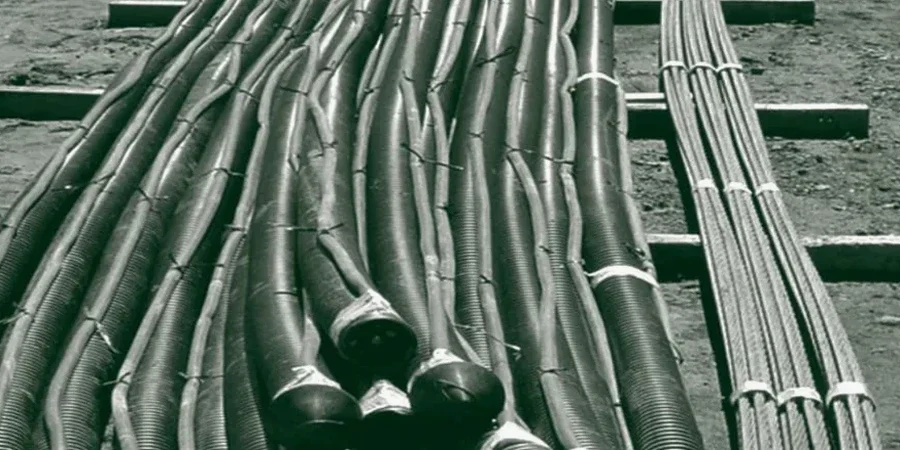
Sherbrooke sits at roughly 140 meters above sea level, but the real elevation change that matters for geotechnical work is the 40 to 50 meters of drop into the Magog and Saint-François river valleys. That relief, combined with a dense urban core built on glaciolacustrine deposits, means that any excavation deeper than 3 meters quickly encounters sloping groundwater tables and sensitive silty clays. In our knowledge across the Estrie region, active and passive anchor design becomes the deciding factor between a straightforward shoring job and a project that drags on through two freeze–thaw cycles. The 1988 Saguenay earthquake—a magnitude 5.9 event felt here in Sherbrooke—reminded engineers that even stable-looking slopes can hide residual weaknesses, which is why we tie every anchor load case back to the seismic hazard values in the NBCC 2020. Before mobilization, we often correlate subsurface data from a test pit campaign along the future wall alignment to confirm the stratigraphy that the anchor bond zone will rely on.
A well-instrumented anchor in Sherbrooke till can hold 300 kN with less than 2 mm of creep over a week—when the bond length is placed in intact material, not in the fractured transition.
Local ground factors
The most common anchor failure we investigate in Sherbrooke starts with a drill rig sitting on a narrow bench halfway down a slope, pulling casing through a lens of saturated silt at 6 meters depth. The operator hits a pocket of artesian water trapped between the till and the bedrock; the hole collapses, the grout is diluted before it sets, and the anchor never develops its design capacity. Nobody notices until the first load test comes up short—and by then, the excavation is already open and the clock is ticking. On a project near the Université de Sherbrooke campus, we saw three anchors fail proof tests in a row because the bond zone had been placed in a weathered schist layer that the preliminary borehole logs had misidentified as competent rock. We resolved it by extending the bond into the fresh rock mass and switching to a post-grouted system with a re-drillable sleeve port, which allowed us to confirm grout pressure at the actual bond depth. The takeaway is simple: in the Eastern Townships, anchor design cannot be separated from real-time drilling observation. A specification written in an office 200 kilometers away will rarely survive first contact with the ground here.
Relevant standards
NBCC 2020 – Division B, Part 4 (Structural Design) for seismic load combinations, CSA A23.3:19 – Design of Concrete Structures (anchorages in reinforced concrete for tied-back walls), ASTM A615 / A722 – High-strength steel bars and prestressing strand for anchor tendons, PTI DC35.1-14 – Recommendations for Prestressed Rock and Soil Anchors (Post-Tensioning Institute), CFEM – Canadian Foundation Engineering Manual (4th ed.) – anchor design and testing procedures
Q&A
What is the difference between active and passive anchors in a Sherbrooke excavation?
Active anchors are stressed to a design load immediately after grout curing—they actively compress the soil mass behind the wall and control deformation from day one. In Sherbrooke, we use them for permanent structures and for deep cuts in sensitive clay where even 10 mm of movement can disturb adjacent foundations. Passive anchors, on the other hand, are not stressed; they only engage when the wall moves enough to mobilize their resistance. We typically specify passive bar anchors for temporary shoring in competent till, where a small amount of wall deflection is acceptable and the simpler installation keeps the schedule moving.
How much does anchor design and testing cost for a typical project in Sherbrooke?
For a medium-sized tied-back wall in the Sherbrooke area—say 30 to 50 anchors—the design, submittal, and on-site testing package usually falls between CA$1,240 and CA$5,000 depending on the number of performance tests required and the complexity of the ground profile. A straightforward temporary shoring job with a uniform till profile sits at the lower end; a permanent wall with double corrosion protection, seismic load cases, and fractured bedrock bond zones moves toward the upper end of that range.
Do you need a rock anchor or a soil anchor in Sherbrooke?
It depends entirely on depth and location. In the downtown core and along the river valleys, many excavations bottom out in the stiff glacial till without ever reaching bedrock; those are soil anchors, with bond lengths designed around the undrained shear strength of the till. Up on the slopes toward Mont-Bellevue or in the industrial parks east of the Saint-François, bedrock is often within 5 to 8 meters of grade—those become rock anchors, and the design shifts to grout-to-rock bond values derived from the compressive strength of the slate or phyllite. We always drill a confirmation hole first to establish the exact depth to competent rock before finalizing anchor lengths.
What testing is required for ground anchors under Canadian standards?
CSA A23.3 and the PTI recommendations require three levels of testing. Performance tests are run on sacrificial anchors before production begins—these go to 133% of design load and measure creep over 60 minutes to confirm the ultimate bond capacity. Proof tests are performed on every production anchor, also to 133% of design load, with a 10-minute creep measurement. Extended creep tests on a minimum of 5% of anchors monitor behavior over 24 hours under sustained load. In Sherbrooke's fractured bedrock, we often add a water-pressure test in the bond zone before grouting to quantify hydraulic conductivity, because excessive water flow during grouting is the most common cause of test failure we see.
Can anchors be installed in winter in Sherbrooke?
Yes, but winter anchor installation here requires a heated grout plant and careful management of the freeze–thaw cycle. The glacial till in Sherbrooke can freeze to a depth of 1.2 to 1.5 meters between December and March, so the upper portion of the drill hole needs to be cased through frozen ground. We use a grout mix with an accelerator and keep the water and aggregate in heated storage; the grout temperature at the nozzle must stay above 10°C to achieve proper set before the ground refreezes around the bond zone. The bigger challenge in winter is not the anchor itself—it is keeping the stressing jack and hydraulic pump functioning at -20°C on a snow-covered bench. We schedule proof testing for the warmest part of the day and pre-heat the equipment in an insulated trailer, which adds about 15% to the field time compared to a summer installation.