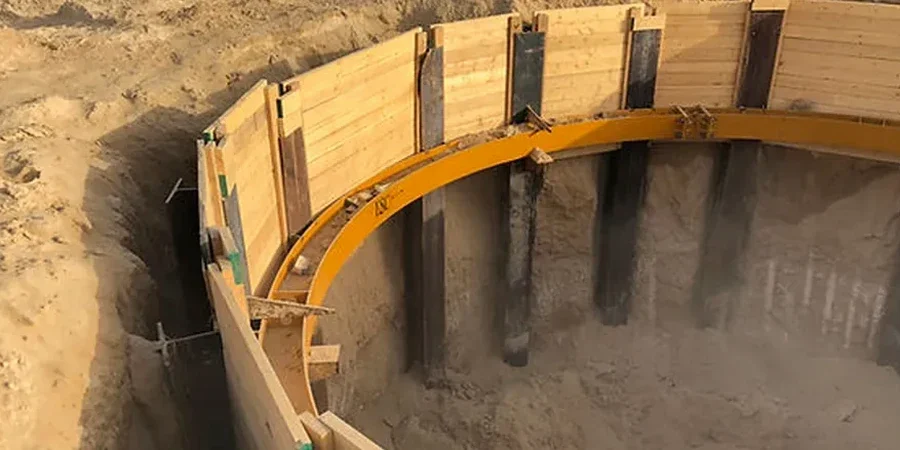
Sherbrooke’s subsoil doesn’t read textbooks. Glacial Lake Vermont left deep, compressible clay layers across the Saint-François River valley, while till ridges east of Mont Bellevue sit on dense, overconsolidated material. NBCC 2020 and CSA A23.3 require a design that accounts for this abrupt lateral variability. A single shallow footing could bridge two completely different bearing regimes. The pile foundation design has to stitch through the soft stuff and anchor into competent till or bedrock, and that means knowing exactly where the transition happens. In practice, the conversation usually starts with a CPT test to map the clay thickness continuously before selecting pile type and toe elevation.
Sherbrooke’s glacial legacy means the pile tip might be in dense till on one side of the site and soft clay on the other—design has to bridge both realities.
Local ground factors
Sherbrooke sits in a moderate seismic zone with a 2% in 50-year ground motion around 0.15–0.25 g on firm ground, but the deep clay pockets amplify that significantly. Site Class E profiles are common along the river terraces, and NBCC 2020 forces a site-specific response analysis for tall or post-disaster buildings. Ignoring the clay means underestimating spectral acceleration at the pile cap. A second risk is downdrag: the compressible silty clay consolidates under new fill or rising groundwater, pulling negative skin friction down the shaft. In one project near the Université de Sherbrooke campus, we measured over 40 kPa of downdrag before the pile reached till. The design has to include a sacrificial bitumen coat or an extended neutral plane calculation, otherwise the structural load plus drag exceeds the geotechnical capacity.
Q&A
What does a pile foundation design package include for a building in Sherbrooke?
A typical package includes a geotechnical design report with pile type selection, axial and lateral capacity curves, settlement analysis, group efficiency factors, and seismic kinematic interaction checks. It also provides pile installation specifications, load test requirements, and construction monitoring criteria. All work follows NBCC 2020 and CSA A23.3.
How much does a pile foundation design cost in Sherbrooke?
Depending on the number of piles, load test scope, and seismic analysis complexity, the design component typically ranges from CA$2,320 to CA$9,230. A site-specific quote is prepared after reviewing the building loads and available geotechnical data.
Why is downdrag such a concern in the Sherbrooke area?
Much of the city lies on compressible silty clay deposited in glacial Lake Vermont. When new fill is placed or groundwater levels change, this clay consolidates and grips the pile shaft, pulling downward. We calculate the neutral plane depth and often specify a bitumen slip layer or an oversized structural section to manage it.