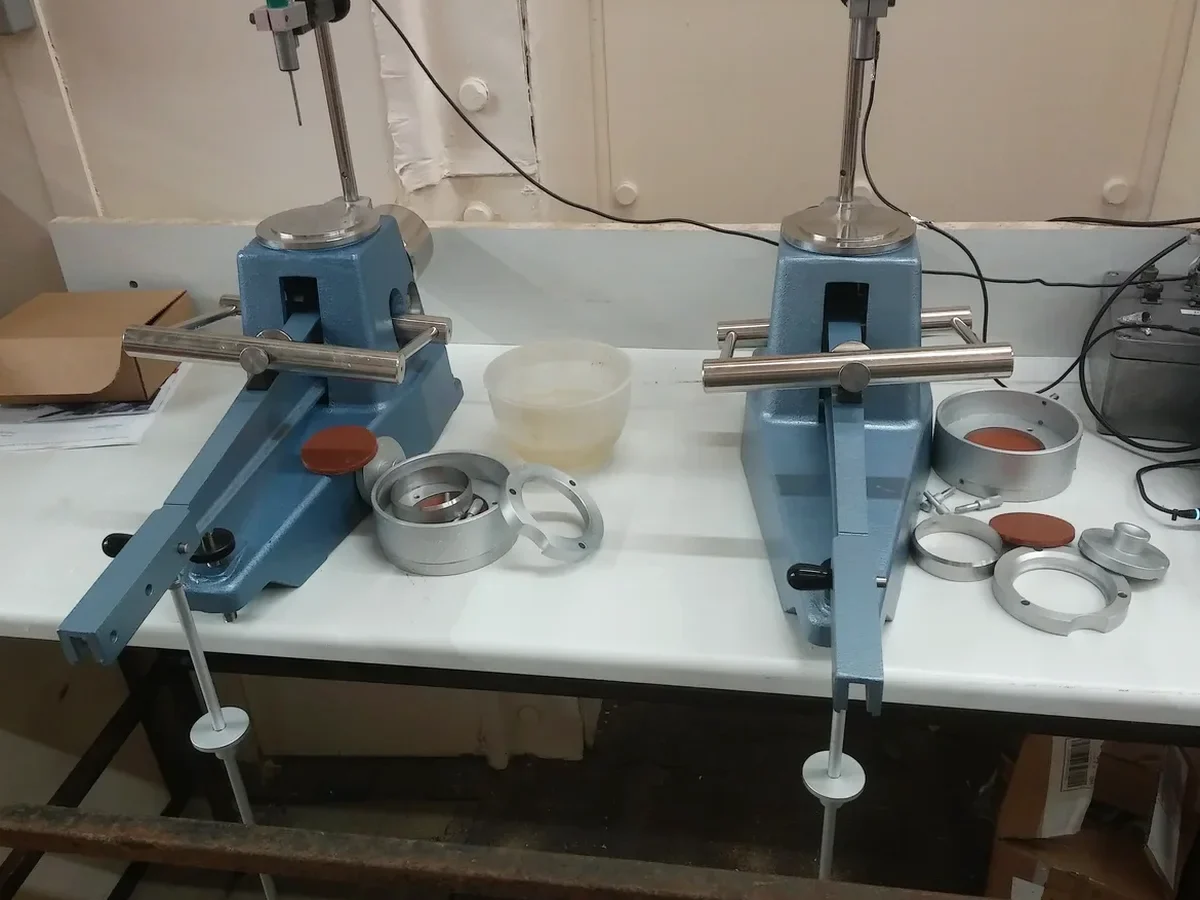
Working the soils around Sherbrooke, you quickly learn that the Saint-François River valley doesn't play by a single set of rules. You can move from a dense, gravelly till on a hillside down to a pocket of sensitive silty clay near the floodplain in less than a hundred meters. We've seen projects stall for weeks because the lab data didn't capture the plasticity of a thin clay seam, which is exactly why we run the Atterberg limits test with the attention to detail that construction schedules demand. When we combine the liquid and plastic limits with a full grain size distribution analysis, we build a mineralogical fingerprint of the soil that directly feeds into your earthworks and foundation strategy, not just a compliance checkbox.
A 10% error in the plastic limit can translate into a 30% overestimate of the safe bearing pressure in fine-grained soils—we don't guess on the lab bench.
How we work
The test itself is a manual, low-tech procedure that demands a steady hand and zero shortcuts. We start by sieving the sample through the No. 40 screen, then incrementally mix the fine fraction with distilled water until the paste just closes a groove at 25 blows in the Casagrande cup—that is your liquid limit. For the plastic limit, the technician rolls threads down to 3 mm diameter until they crumble, which gives us the boundary where the soil stops behaving plastically and starts fracturing. In Sherbrooke's glacial lake deposits, we often see liquid limits pushing past 50%, which puts the material squarely in the high-plasticity silt category. Before a contractor puts a compactor on the pad, it is common practice to cross-reference these results with a sand cone density test to confirm that the target moisture content is achievable with the material at hand.
Local ground factors
The risk that keeps geotechnical engineers up at night in Sherbrooke is the presence of Champlain Sea silts—locally called 'varved clays'—that can lose most of their strength when remolded. The National Building Code of Canada (NBCC) explicitly requires classification of fine-grained soils for seismic site response, and you cannot get a reliable Site Class without knowing the plasticity index. A soil with a PI over 30% behaves fundamentally differently during freeze-thaw cycles than a lean silt with a PI of 5%; the former heaves, traps water, and loses bearing capacity in the spring, while the latter drains predictably. Skimping on the Atterberg test here isn't just a paperwork gap—it is a direct gamble against the 1,100 mm of annual precipitation and the 120-day frost penetration depth we design for in the Estrie region.
Relevant standards
ASTM D4318-17e1: Standard Test Methods for Liquid Limit, Plastic Limit, and Plasticity Index of Soils, CSA A23.3-19: Design of Concrete Structures (fine aggregate plasticity requirements), ASTM D2487-17: Unified Soil Classification System (USCS), National Building Code of Canada (NBCC) 2020, Part 4: Seismic Site Classification
Q&A
How much does an Atterberg limits test cost in Sherbrooke?
For a standard liquid and plastic limit determination on a single sample, you are looking at a range of CA$80 to CA$140, depending on whether you need the full four-point liquid limit curve or a faster two-point verification. If you bundle it with a grain size analysis or a full USCS classification package, the per-sample rate becomes more economical. We always offer a fixed quote before starting so there are no surprises on the invoice.
Which soil types in the Sherbrooke area most urgently require Atterberg testing?
The varved silts and clays from the old glacial lakes—particularly in the Magog and Saint-François corridors—are the highest priority. These soils can have a plasticity index above 25%, which puts them in the high-volume-change category. Any foundation excavation that encounters a gray, laminated silt layer should trigger an immediate Atterberg test to confirm the drainage and heave potential before the footing concrete is poured.
How long does the lab take to return results?
The physical test itself, including sample preparation, takes about four hours once the sample is in the lab. Our standard reporting time is 48 hours from sample drop-off, but we do offer a 24-hour rush service for active earthworks operations where the compaction window is closing. The key time sink is the overnight oven drying for the associated moisture content, which cannot be rushed without compromising accuracy.
Can you perform the test on samples we already collected?
You can absolutely bring us bag samples from your own site investigation. We need a minimum of 200 grams of the material passing the No. 40 sieve, kept at its natural moisture content in a sealed plastic bag. If the sample has dried out, we can still run the test, but the Liquidity Index calculation won't be possible—we will flag that in the report so the design team knows the limitation.