← Home · Laboratory

Laboratory CBR Test in Sherbrooke: Accurate Bearing Capacity for Pavement Design

Together, we solve the challenges of tomorrow.

LEARN MORE →

Sherbrooke's development as an industrial hub in the 19th century, powered by the Magog River, left a patchwork of fill materials and glacial till across the city. When modern infrastructure expands into these areas—whether it's a new commercial lot on Rue King Ouest or a residential collector in Fleurimont—the subgrade rarely behaves as expected. A laboratory CBR test cuts through the guesswork by measuring the bearing capacity of the soil under controlled moisture and density conditions. We run soaked CBR specimens to simulate the worst-case scenario Sherbrooke's freeze-thaw cycles throw at pavements, because a road base that fails in April costs more to repair than one designed with real numbers from the start.

A soaked CBR value below 3% in Sherbrooke's silty tills means you're building on a sponge—either remove it or stabilize it before the first frost cycle turns it into a liability.

How we work

Take a recent project near the Université de Sherbrooke campus. The contractor hit a silty sand layer at 600 mm depth that looked decent in a hand auger but turned to mush after a rainstorm. We compacted remolded samples at 95% of modified Proctor and ran the penetration test. The soaked CBR came back at 4.8%—below the 6% minimum the City of Sherbrooke requires for residential streets. That single number changed the pavement structure from 150 mm of granular base to a 300 mm sub-base plus geotextile separation.

The CBR test here isn't just about meeting a spec. It tells you whether the local glacial till—the same till that forms the drumlins around Lac des Nations—will support traffic loads after spring thaw saturates the subgrade. For jobs where the pavement meets deeper fill, we often pair the CBR with a plate load test on the compacted lift to verify stiffness before placing the asphalt.
Laboratory CBR Test in Sherbrooke: Accurate Bearing Capacity for Pavement Design
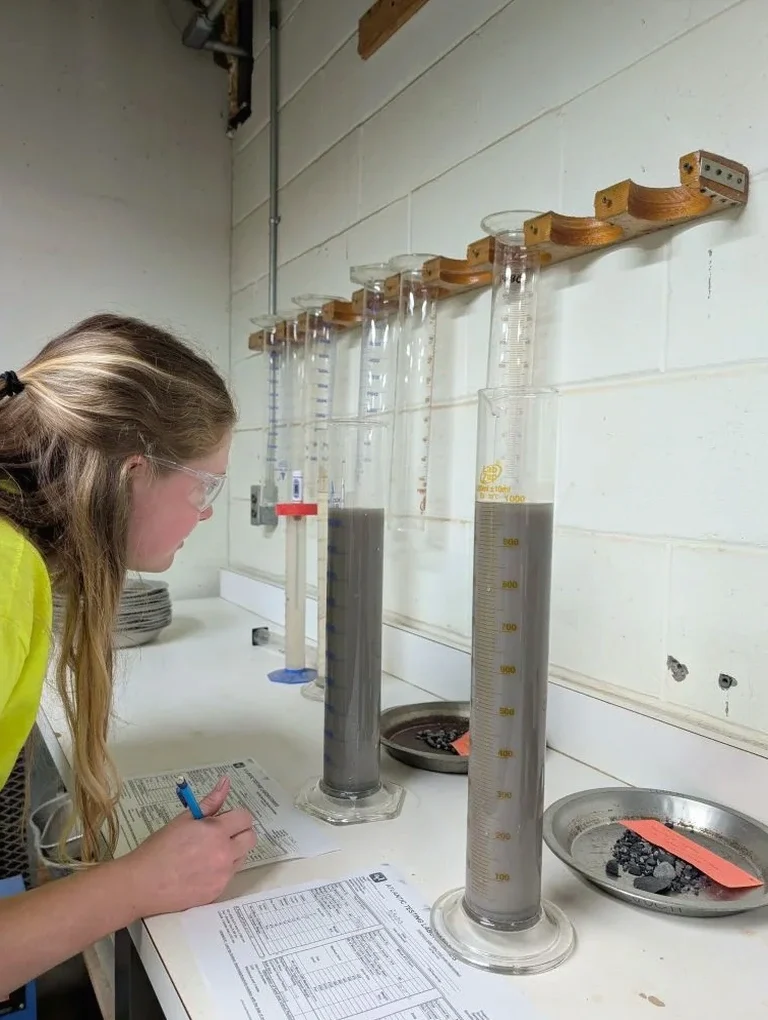
Technical reference image — Sherbrooke

Local ground factors

The CBR machine in our Sherbrooke lab—a motorized loading frame with a 50 kN capacity—runs penetration tests at a constant rate of 1.27 mm per minute. It's straightforward equipment, but the risk isn't in the machine. The risk is in the sample. Sherbrooke's silty tills and glaciolacustrine clays lose strength fast when water content drifts even 1% above optimum. A sample compacted too wet, or soaked without proper surcharge, gives a CBR of 2% when the actual in-situ material could hold 8%. That false low sends a contractor into expensive over-excavation or lime stabilization that wasn't needed. On the flip side, a sample compacted dry and tested unsoaked inflates the number—and the pavement fails after two winters. We run duplicate specimens on every job because the cost of a bad CBR value in the Eastern Townships shows up in potholes three years later.

Need a geotechnical assessment?

Reply within 24h.

Email: info@geotechnical-engineering.org

Technical parameters

ParameterTypical value
Standard followedASTM D1883-21
Sample preparationRemolded at optimum moisture content (modified Proctor per ASTM D1557)
Soaking period96 hours with swell measurement
Penetration rate1.27 mm/min (0.05 in/min)
Surcharge weight4.54 kg annular weights minimum
Typical sample diameter152.4 mm (6-inch mold)
Reported valuesCBR at 2.54 mm and 5.08 mm penetration, swell percentage

Related services

01

Soaked and Unsoaked CBR Determination

We compact samples at target moisture and density, then run penetration tests on both soaked (96-hour immersion) and unsoaked specimens. The soaked value governs pavement design in Sherbrooke's frost-susceptible soils, while the unsoaked comparison shows how much strength the subgrade loses with saturation.

02

Pavement Structure Thickness Design

Using the CBR value, traffic projections, and MTQ design charts, we recommend granular base and sub-base thicknesses that meet both structural and frost-protection requirements for the Eastern Townships climate zone.

Relevant standards

ASTM D1883-21: Standard Test Method for California Bearing Ratio (CBR) of Laboratory-Compacted Soils, ASTM D1557: Modified Proctor compaction, CSA A23.1/A23.2: Concrete materials and methods (referenced for pavement quality control), MTQ (Ministère des Transports du Québec) Cahier des normes – Tome II, Chapitre 4

Frequently asked questions

What does a laboratory CBR test cost in Sherbrooke?

A standard laboratory CBR test on a single remolded sample, including compaction and 96-hour soaking, runs between CA$200 and CA$290. The exact price depends on whether you need just the soaked value or both soaked and unsoaked, and how many points we're testing on the moisture-density curve. Most pavement jobs in Sherbrooke require at least two specimens to bracket the expected field conditions, which keeps the total under CA$600.

How long does it take to get CBR test results back?

The soaking period alone is 96 hours per ASTM D1883. Add compaction, setup, penetration testing, and reporting, and you're looking at seven to ten calendar days from the moment we receive the bulk sample. Rush processing isn't possible on the soaking phase—the water needs time to saturate the specimen—but we can expedite the report once the penetration data is in hand.

Do I need a field CBR or a laboratory CBR for my Sherbrooke project?

It depends on the project phase. A field CBR test on in-situ soil gives a quick number during construction, but the laboratory CBR under controlled moisture and density conditions is what design engineers use to size the pavement structure. For new subdivision roads in Sherbrooke, the City typically wants laboratory CBR values at optimum moisture and soaked, because that's the condition that governs long-term performance. If you're troubleshooting an existing road, a field CBR with a sand cone density test alongside it tells you what's happening right now in the compacted layer.

What CBR value is considered acceptable for residential streets in Quebec?

The MTQ and most Sherbrooke-area municipalities look for a minimum soaked CBR of 6% in the subgrade for local residential streets. Below that, you're into sub-base thickening or stabilization territory. For arterial roads and commercial parking lots with heavier traffic, the target usually jumps to 10% or higher. If your subgrade tests below 3% soaked CBR—common in the clay-rich pockets near the Saint-François River floodplain—you'll likely need a full geotextile separation layer and imported granular fill to bridge the weak zone.
Location and service area

We serve projects in Sherbrooke and surrounding areas. More info.

View larger map