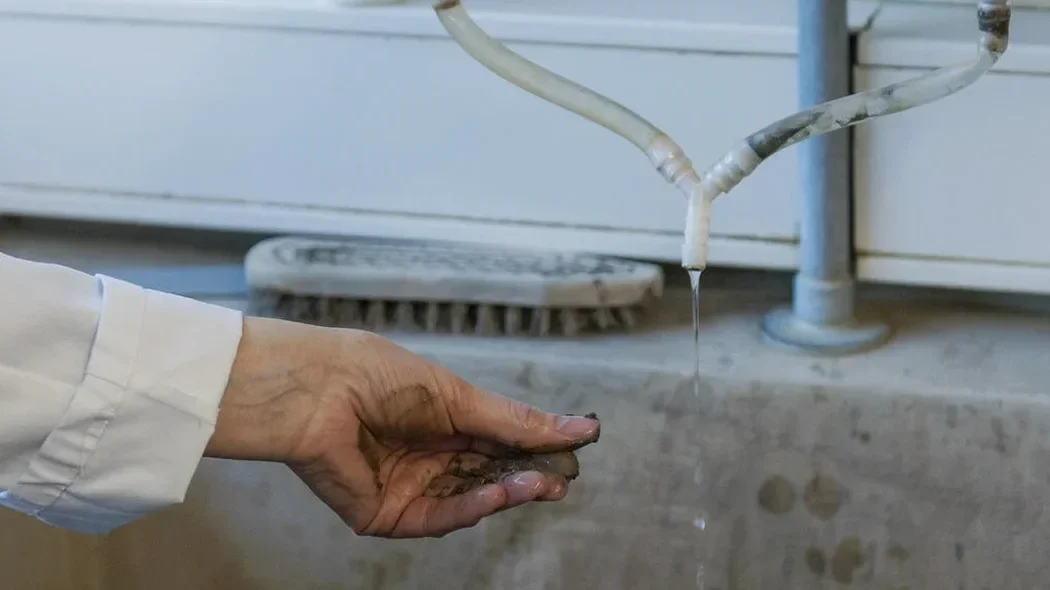
The hydrogeological contrast between Sherbrooke's eastern plateau and the Magog River floodplain demands fundamentally different approaches to permeability assessment. A project near the Université de Sherbrooke campus might encounter dense glacial till with scattered lenses of sand, while groundwork in the industrial parks of the Saint-Élie sector often hits fractured slate and quartzite of the Appalachian foothills. The same foundation depth can yield orders-of-magnitude difference in hydraulic conductivity between these zones. Field permeability testing using the Lefranc method in soil and the Lugeon test in rock provides the direct, in-situ measurements that laboratory remolded samples simply cannot replicate. Our team runs these tests within the same borehole used for stratigraphic logging, correlating water pressure response with the actual fracture spacing and infilling observed in the recovered core.
A single Lugeon test across a fractured slate zone in Sherbrooke's Appalachian foothills provides more design-relevant data than twenty laboratory permeability tests on intact core samples.
How we work
The National Building Code of Canada references CSA A23.3 for concrete structures, but for geotechnical site investigations, the real backbone in Sherbrooke is the methodology aligned with ASTM D6391 for packer testing in rock and the variable-head procedures adapted for the Lefranc test in soils. Why is this critical here? Because the city sits within the Saint-François River watershed, where municipal regulations on groundwater control during excavation require verifiable conductivity data before dewatering permits are issued. A standard test program begins with thorough borehole cleaning to remove drilling mud from the test zone. For the Lugeon test, a pneumatic packer isolates a specific fractured segment; water is injected at five pressure stages following Houlsby's interpretation criteria, which distinguishes between laminar flow through tight fissures, turbulent flow in open joints, and hydraulic fracturing of the formation. The Lefranc test, performed in a cased section of granular soil, can be run as a falling-head or constant-head procedure depending on whether the material is expected to be low or high permeability. The entire sequence is documented with pressure transducers recording at one-second intervals, producing a time-drawdown curve that reveals any boundary effects or leakage past the packer.
Local ground factors
Sherbrooke's stratigraphy is dominated by the Lennoxville Till, a dense, silty diamicton deposited during the last glaciation, overlying highly fractured meta-sedimentary bedrock. The water table across much of the city sits within 2 to 4 meters of the surface, but perched aquifers within sand stringers in the till are common and unpredictable. The real hazard emerges during deep excavations for parkades or foundation work near the Saint-François River: misjudging the rock mass permeability by relying solely on core logging leads to undersized dewatering systems, uncontrolled inflows, and in the worst cases, base heave or slope instability. In the Lugeon test, a sudden spike in water take at the highest pressure step often indicates hydro-jacking of sub-horizontal fractures, a condition that must be accounted for in grouting design and temporary shoring loads. Our reports flag these non-linear flow behaviors explicitly because they change the entire groundwater control strategy.
Q&A
How long does a Lugeon test take in a Sherbrooke borehole?
A complete five-stage Lugeon test in a single 3-meter test interval typically requires 90 to 120 minutes of active testing after borehole preparation. The most time-consuming phase is borehole conditioning: the test zone must be flushed clean of drill cuttings and the packer seated in competent rock above the interval. We run pressure stages of 10 minutes each, with the descending-pressure steps serving to verify that no permanent hydraulic fracturing occurred during the peak injection phase. Including rig setup, packer inflation checks, and transducer calibration, a single test interval occupies roughly half a day of field time.
What is the typical cost range for field permeability testing in Sherbrooke?
Budget between CA$900 and CA$1,340 per test interval, depending on access conditions, depth, and whether the test is performed within an existing borehole or requires a dedicated drilling setup. A Lugeon test in deep bedrock with a double packer arrangement falls at the upper end of that range due to the additional time for packer placement and pressure-stage monitoring. Lefranc tests in soil are generally at the lower end. Mobilization, traffic control on Sherbrooke streets, and engineering interpretation are quoted separately based on project scope.
How do Lefranc and Lugeon tests differ from a laboratory falling-head permeameter test?
The fundamental difference is scale and representativeness. A laboratory permeameter measures flow through a 75 mm diameter remolded or intact sample, which captures matrix porosity but completely misses fractures, fissures, sand lenses, and other macro-features that dominate field-scale flow. The Lefranc test in soil integrates the response of a zone roughly 50 to 100 cm around the borehole screen, while a Lugeon test in rock pressurizes an entire 3-meter fractured interval. In Sherbrooke's fractured meta-sedimentary rock, laboratory tests on intact core consistently underestimate mass permeability by one to three orders of magnitude compared to the Lugeon value.
Which Sherbrooke projects typically require Lugeon testing?
Any project involving rock excavation below the water table, permanent cut slopes in rock, or environmental containment in fractured bedrock triggers the need for Lugeon testing. Common examples include the deep foundations for hospital expansions, underground parking structures in the downtown core, and stormwater infiltration galleries where the design must prove adequate percolation capacity. Grouting programs for dam abutments or tunnel pre-excavation along the Saint-François River also rely heavily on pre-injection and post-injection Lugeon tests to verify that target permeability reductions have been achieved.
How are the test results used in dewatering design for Sherbrooke excavations?
The field conductivity values feed directly into analytical models, such as the Dupuit-Thiem equation for steady-state radial flow, and into numerical groundwater models built in MODFLOW or SEEP/W. For a typical 6-meter excavation in the Lennoxville Till, a Lefranc-derived K-value of 1 x 10^-6 m/s translates to a manageable inflow rate manageable with sump pumping. If the test reveals sand lenses with K-values two orders of magnitude higher, the design shifts to a wellpoint system with closer spacing. In rock, a Lugeon value above 10 Lu in the upper 5 meters of bedrock signals the need for a cutoff wall or a grout curtain to prevent drawdown-induced settlement of adjacent structures.