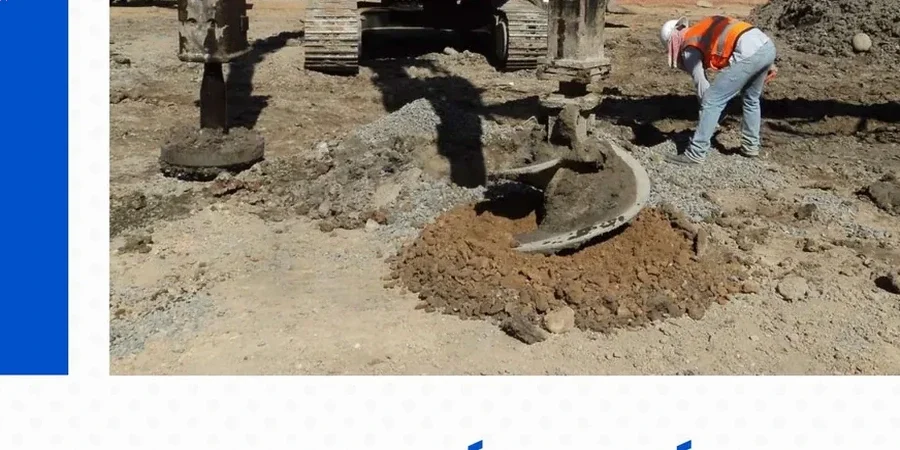
In Sherbrooke, the Saint-François River floodplain leaves pockets of compressible clay and loose silt that make shallow footings a gamble. We see it in Bromptonville, in Rock Forest, and along the Magog River corridor — soft ground where a standard footing just won't cut it. Stone column design replaces about 15 to 35 percent of the weak soil with compacted gravel columns, shifting load to a stiffer composite mass. That means less settlement, faster drainage, and a bearing capacity jump without the cost of deep piles. For warehouse slabs, embankments, and mid-rise structures on the city's post-glacial sediments, it is often the most practical ground improvement path. We combine site-specific CPT data with test pit logging to map the compressible layer before any column layout is drafted.
A 25% replacement ratio in Champlain Sea clay can triple the composite modulus and cut total settlement by over half.
Q&A
What does stone column design cost for a typical Sherbrooke commercial lot?
For a standard commercial footprint in the Sherbrooke region, design fees and reporting typically range from CA$1,750 to CA$6,550 depending on the number of columns, the complexity of the soil profile, and the level of post-installation verification required.
How long does installation take on a soft clay site?
A rig installing 80 to 120 columns on a 1,500 m² site in Sherbrooke's Champlain clay can complete the work in 5 to 8 working days. The vibratory probe advances at roughly 1 to 2 meters per minute. Curing time is zero — the columns are load-ready immediately after compaction, though we often specify a short preload period to confirm settlement rates.
Can stone columns replace piles under a 4-storey building?
Yes, in many Sherbrooke soil profiles. If the compressible layer is less than 15 meters deep and the undrained shear strength is above 15 kPa, a well-designed column grid with a rigid load transfer platform can support 4-storey loads at a fraction of the cost of driven piles. We run a settlement analysis and bearing capacity check to confirm feasibility before committing to the approach.