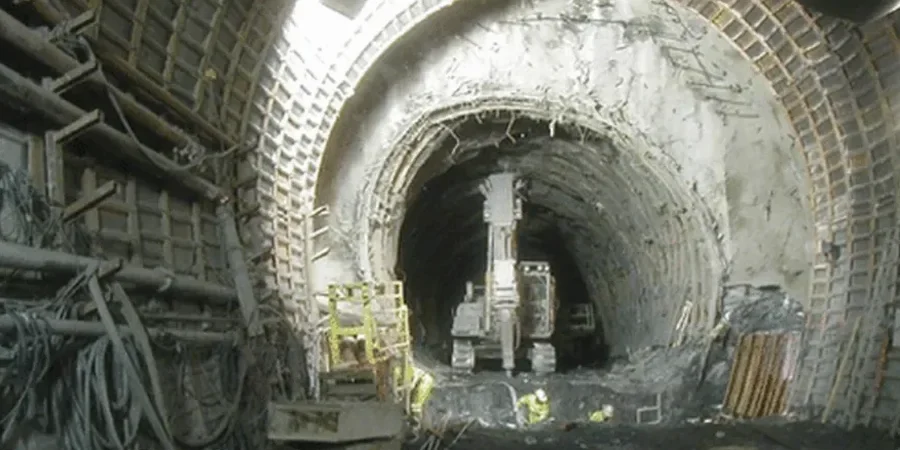
Sherbrooke's growth from a mill town at the confluence of the Magog and Saint-François rivers into a major regional hub has pushed infrastructure into complex terrain. The valley's deep deposits of sensitive post-glacial clay and silts, a legacy of the ancient Champlain Sea, present a unique challenge for underground construction. Any tunnel project here must begin with a careful geotechnical analysis for soft soil tunnels, one that accounts for the city's layered alluvial history. The industrial heritage of the Hydro-Sherbrooke district, for instance, sits directly atop these compressible soils, demanding refined subsurface models. Early integration of a cone penetration test can rapidly map the vertical extent of these soft layers, providing a continuous profile that traditional borings might miss in the transition zones between the glacial till and the overlying clay.
In Sherbrooke's Champlain Sea clays, the tunnel face doesn't just cave; it extrudes. The difference between stable advance and a sinkhole is a matter of kilopascals.
How we work
Sherbrooke's humid continental climate, with its deep winter frost penetration and heavy spring freshet, creates a dynamic hydrological environment that directly affects soft-ground tunneling. The seasonal saturation of the upper crust, followed by rapid thaw, alters pore pressures in the shallow clay, demanding an analysis that spans the full annual cycle. A proper geotechnical analysis for soft soil tunnels here uses advanced laboratory testing, including triaxial shear under consolidated-undrained conditions with pore pressure measurement, to replicate these in-situ stress paths. The methodology links field investigation with finite element modeling to predict the excavation's influence zone, a critical step when tunneling beneath Sherbrooke's densely packed urban core. The interpretation of these results guides the selection of pre-support systems, such as pipe umbrellas or ground freezing, which are often essential where the clay's plasticity index indicates a propensity for squeezing rather than stable arching.
Local ground factors
With a metropolitan population exceeding 220,000, Sherbrooke's development pressure on soft ground corridors is intensifying. The biggest threat in this region is not just settlement but the potential for face instability during excavation through the sensitive Leda clay, which can lose significant strength when disturbed. A geotechnical analysis for soft soil tunnels in this context must rigorously evaluate undrained shear strength parameters to prevent a catastrophic chimney-like collapse. The analysis must also quantify the consolidation settlement under the final lining, as the thick clay sequences along the riverbanks can compress for years, threatening overlying roads and century-old brick buildings. Failure to model the groundwater regime accurately, particularly where fractured bedrock rises abruptly, introduces the risk of sudden inflows that can destabilize the tunnel heading before any support can be installed.
Q&A
What makes Sherbrooke's soil particularly challenging for tunneling?
The presence of Champlain Sea clay, also known regionally as Leda clay, is the primary challenge. This marine deposit is highly sensitive, meaning its structure collapses when disturbed, losing most of its strength. The Saint-François River valley also features complex interfaces between this soft clay, glacial till, and the underlying slate bedrock, creating mixed-face conditions.
How much does a geotechnical analysis for a soft soil tunnel cost in Sherbrooke?
The scope of analysis varies significantly with tunnel length, depth, and the density of the investigation program. For a preliminary analysis supporting a tunnel feasibility study in the Sherbrooke region, fees typically range from CA$6,300 to CA$25,900, depending on the required number of laboratory tests and the complexity of the numerical modeling.
Which field tests are most critical for soft-ground tunnels?
A combination of methods is essential. CPTu (piezocone) soundings are highly valuable for continuous profiling of the soft clay and identifying thin silt seams that control drainage. High-quality piston sampling is then required for advanced lab testing. Vane shear tests in boreholes also offer a direct measure of in-situ undrained shear strength and sensitivity.
How do you prevent a tunnel from sinking in soft clay?
Tunnels float if their weight is less than the excavated soil, but they settle if the soil beneath compresses under the lining load. We prevent excessive settlement by designing a lining that is light enough or by improving the ground. The geotechnical analysis for soft soil tunnels focuses on limiting the long-term consolidation strain by ensuring the factor of safety against bearing failure of the invert is adequate.