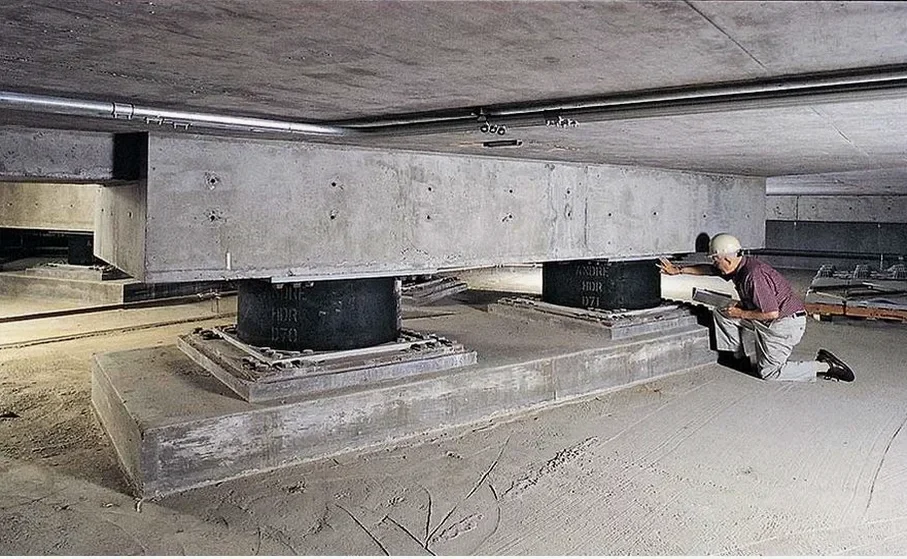
Sherbrooke’s growth from a mill town at the confluence of the Magog and Saint-François rivers into a manufacturing and university hub means we deal with a patchwork of foundation conditions every day. Terrace gravels, glaciolacustrine silts, and occasional pockets of soft clay all sit on top of the Appalachian bedrock, which isn’t exactly flat. When a project calls for base isolation, the isolators don’t operate in a vacuum — they work in tandem with the soil column beneath the structure. Our lab gets involved early, running resonant column and cyclic triaxial tests to pin down shear modulus degradation and damping curves at strains that match the design basis earthquake. For Sherbrooke engineers, this means the isolator properties aren’t just pulled from a catalog; they’re checked against the actual ground response we measure from samples taken on-site. That tie-in between lab dynamics and structural modeling matters a lot in a city where the seismic hazard is moderate but the soil variability is high. We often see projects combine our dynamic testing with a standard penetration test (SPT) drilling program so the geotechnical model captures both the shallow variability and the deeper bedrock profile that controls wave propagation.
In Sherbrooke, isolator displacement demand is only as reliable as the shear modulus degradation curve measured on the actual soil — catalog values don’t account for Eastern Townships geology.
Relevant standards
NBCC 2020 — National Building Code of Canada, seismic provisions, CSA A23.3 — Design of concrete structures, seismic requirements, ASTM D3999 — Standard Test Methods for the Determination of the Modulus and Damping Properties of Soils Using the Cyclic Triaxial Apparatus, ASTM D4015 — Standard Test Methods for Modulus and Damping of Soils by Resonant-Column Method
Q&A
What dynamic soil properties does a base isolation design actually need from the lab?
The structural engineer needs three things: the small-strain shear modulus Gmax (from bender elements or resonant column), the modulus reduction curve G/Gmax versus shear strain, and the damping ratio curve versus shear strain. These go directly into the soil-structure interaction model that estimates isolator displacement and period shift. For Sherbrooke sites, we typically run a resonant column test for the low-strain range and a cyclic triaxial series for the moderate-to-large strain range, then merge the two curves into one continuous dataset.
How much does a dynamic soil testing program for base isolation cost in Sherbrooke?
A complete program — resonant column, cyclic triaxial on two to three specimens, and bender element Vs measurements — usually falls between CA$5,270 and CA$11,450 depending on the number of specimens and the strain levels required. Projects with multiple boreholes or deeper soil columns push toward the upper end because we need to characterize each distinct layer that affects wave propagation.
Which NBCC site class is most common for base-isolated buildings in Sherbrooke?
We see a mix. The river terraces around downtown and Lennoxville often classify as Site D or even E where soft silty clay exceeds 10 meters. The higher terraces and areas near the Université de Sherbrooke tend toward Site C because till or shallow bedrock stiffens the profile. The site class matters a lot — moving from C to D can increase the spectral acceleration the isolation system must accommodate, so we always verify Vs30 with measurements rather than relying on blow-count correlations.
Can you test Sherbrooke’s sensitive silts without disturbing the sample structure?
Yes, that is exactly why we use thin-walled Shelby tube samples and trim them under controlled humidity in the lab. Sherbrooke’s glaciolacustrine silts can lose strength if they dry out or get remolded during handling. Our cyclic triaxial setup applies back-pressure saturation and consolidates the specimen at in-situ stress before any cyclic loading begins, so the dynamic properties reflect the soil as it exists in the ground, not as a disturbed remnant.
Does the lab provide the input file for a site response analysis, or just the raw test data?
We deliver both. The standard report includes the normalized modulus reduction and damping curves, Gmax, and the Vs profile. If the design team is running a 1D analysis in DEEPSOIL, SHAKE, or similar software, we can format the data to match the required input structure. For Sherbrooke projects, we often include a comparison to published curves for similar Eastern Townships soils so the engineer can see how the measured behavior differs from generic models.