← Home · Geophysics

MASW / VS30 Testing in Sherbrooke – Shear Wave Velocity for Site Classification

Together, we solve the challenges of tomorrow.

LEARN MORE →

Sherbrooke sits at 180 m elevation in the St. Francis River valley, where the overburden can swing from dense glacial till to 30 m of soft Champlain Sea clay within a single lot. That contrast is exactly what drives the need for a reliable Vs30 measurement under NBCC 2020. The MASW method gives us a direct shear-wave velocity profile without drilling, which matters when access is tight between century-old triplexes on King Street or when the water table sits at 1.5 m in Lennoxville. We run active-source MASW with a 24-channel seismograph and 4.5 Hz geophones, processing the fundamental-mode Rayleigh wave dispersion curve on site. For deeper profiles, we combine it with the seismic refraction method to cross-check bedrock depth, especially in zones where the till–rock interface is irregular.

The Vs30 number is not the deliverable — the deliverable is knowing whether your Sherbrooke site is Class C, D, or E without drilling a single borehole.

How we work

In Estrie, we often see a false refusal signature: a dense layer at 8–12 m that looks like bedrock on a standard penetration log but is actually a boulder-rich lodgement till. MASW cuts through that ambiguity. The shear-wave velocity contrast between the till and the underlying shale of the Saint-François Group is sharp enough that the dispersion curve shows a clean break at the true rock interface. For sites with loose saturated silts near the Magog River, we recommend pairing the MASW survey with a liquefaction assessment because the Vs30 alone flags the site class, but the liquefaction analysis needs the fines content and SPT blow counts to complete the picture. Our field crew can lay out a 92 m spread on a standard residential lot, and we process the data the same day using the multi-station analysis of surface waves algorithm with a 5% RMS error threshold on the picked dispersion curve.
MASW / VS30 Testing in Sherbrooke – Shear Wave Velocity for Site Classification
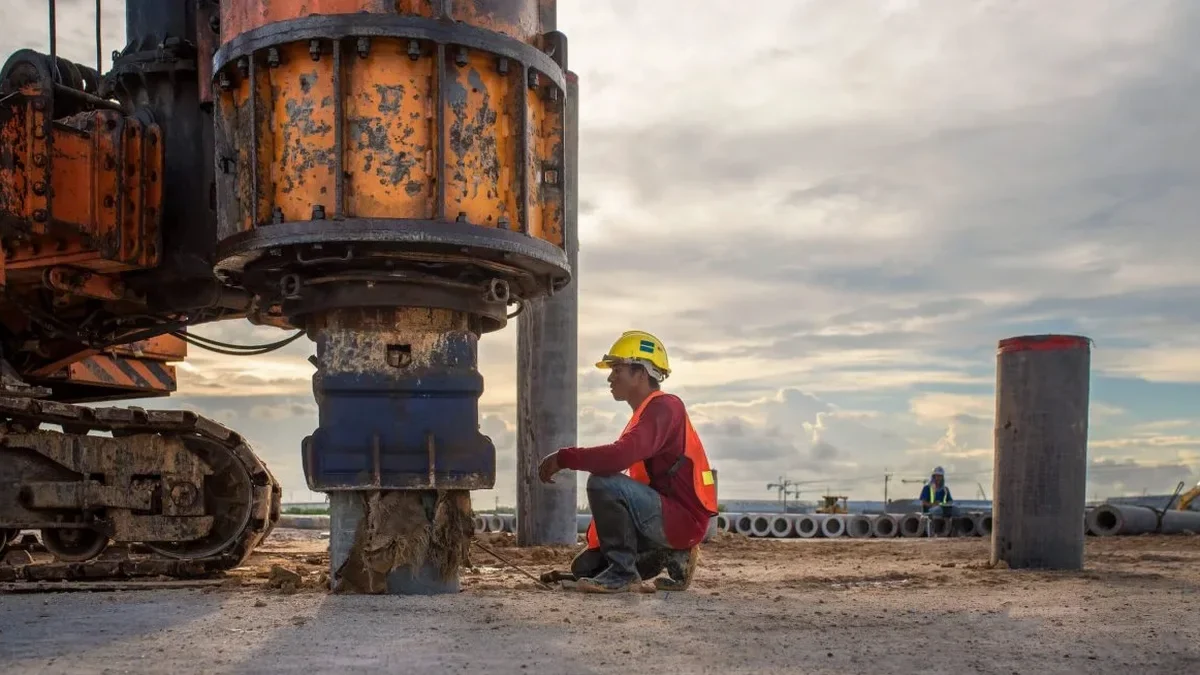
Technical reference image — Sherbrooke

Local ground factors

NBCC 2020 Sentence 4.1.8.10(1) requires a site-specific shear-wave velocity measurement for structures on Site Class E or when the site class is uncertain by more than one category. In Sherbrooke, the geological complexity — glacial lake sediments overlying fractured shale — makes default assumptions risky. A site classified as Class C using generic travel-time correlations could actually be Class E if the clay thickness exceeds 10 m. The consequence is a lateral force underestimation that cascades into the structural design. We have seen this on infill projects in the borough of Fleurimont, where adjacent lots had Vs30 values differing by 120 m/s because of buried paleochannels. CSA A23.3-19 also references Vs30 for concrete structure ductility requirements, so the number feeds directly into the reinforcement detailing. We deliver the processed SEG-2 field files alongside the dispersion curve, so the geotechnical reviewer can audit every pick.

Need a geotechnical assessment?

Reply within 24h.

Email: info@geotechnical-engineering.org

Technical parameters

ParameterTypical value
MethodActive-source MASW, 24-channel sledgehammer source
Spread length46–92 m, configurable to lot geometry
Investigation depthTypically 20–30 m; deeper with passive-source supplement
Vs30 computationPer NBCC 2020 Table 4.1.8.4.A, travel-time average
Site class outputClass C (360–760 m/s), D (180–360 m/s), or E (<180 m/s)
Seismograph24-bit, 1024 ms record, 0.5 ms sampling interval
Geophone frequency4.5 Hz vertical-component, spike-coupled to ground
Dispersion analysisFrequency–velocity domain, fundamental mode tracked manually

Related services

01

MASW for Site Classification

Single-line active-source survey with Vs30 computation per NBCC 2020. Report includes dispersion curve, 1D Vs profile, and site class letter. Suitable for new residential, commercial, and institutional lots.

02

MASW + Liquefaction Screening

Combined survey where Vs30 is used alongside SPT data to screen for liquefaction susceptibility in Sherbrooke's silty floodplain deposits. We apply the Andrus & Stokoe (2004) Vs-based simplified procedure.

03

2D MASW Profile for Heterogeneous Sites

Multiple spreads stitched into a continuous 2D shear-wave velocity cross-section. Used when the overburden thickness varies sharply across the footprint, such as lots adjacent to the St. Francis River escarpment.

Relevant standards

NBCC 2020 – Sentence 4.1.8.10, seismic site classification, CSA A23.3-19 – ductility provisions referencing Vs30, ASTM D5777-18 – seismic refraction (complementary method), ASTM D7400-19 – downhole seismic (when borehole exists)

Frequently asked questions

What is the cost of a MASW survey for a residential lot in Sherbrooke?

For a standard residential lot in Sherbrooke requiring a single active-source MASW line with Vs30 computation and a signed site classification report, the range is CA$2,460 to CA$4,310 depending on spread length, access conditions, and whether passive-source supplementation is needed for deeper profiles.

How does MASW compare with a borehole for site classification?

MASW gives you the shear-wave velocity directly, which is what NBCC 2020 needs for site class. A borehole gives you stratigraphy and N-values, but the Vs has to be estimated from correlations — and those correlations can be off by 30% in Sherbrooke's mixed glacial sediments. We often do both: the borehole for bearing capacity and the MASW for the velocity profile.

Does frozen ground affect the MASW measurement in winter?

Yes. In Sherbrooke, the frost penetration reaches about 1.2 m by February. A frozen crust can create a high-velocity cap that masks the true Vs of the underlying soil. We schedule MASW surveys between April and November where possible, or we couple the geophones below the frost layer if winter work is unavoidable.

What is the minimum lot size needed for a MASW survey?

We can work with a 23 m clear line, which gives a 10–12 m investigation depth — enough to compute Vs30 for most Sherbrooke sites where the bedrock is shallower than 15 m. For deeper profiles, we need 46 m or more, which is usually available on suburban lots in Rock Forest or Saint-Élie.
Location and service area

We serve projects in Sherbrooke and surrounding areas.

View larger map