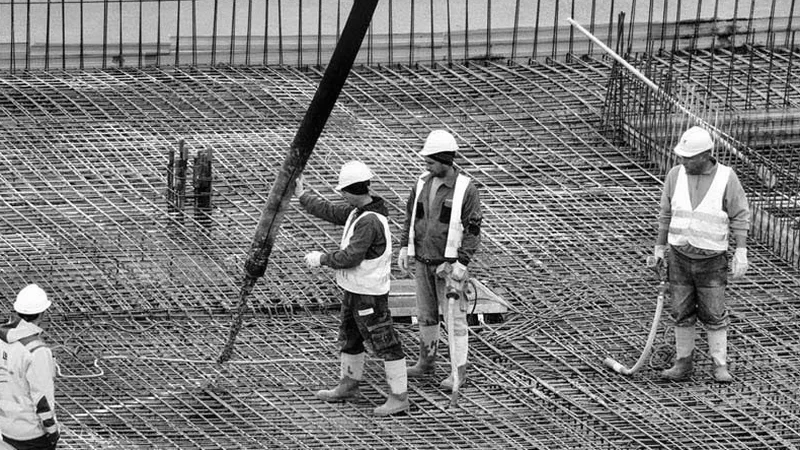
We’ve reviewed local projects where the entire mat foundation geometry was sized using assumed bearing pressures, only to discover during excavation that the site sat on a lens of sensitive Champlain Sea clay—a material that loses nearly all strength when disturbed. In Sherbrooke’s dissected glacial terrain, assuming uniform subgrade reaction across a large raft is the fastest route to differential settlement and structural cracking. The Saint-François River valley and the surrounding Appalachian foothills create abrupt transitions from dense till to compressible silts over short distances, which is precisely why NBCC 2015 and CSA A23.3 demand a site-specific geotechnical investigation before finalizing any mat foundation design. Before committing to reinforcement schedules, we pair in-situ testing with a CPT test to delineate the exact depth of competent bearing strata, eliminating the guesswork that drives up concrete volumes unnecessarily.
A raft foundation on Champlain Sea clay without subgrade reaction calibration is not a foundation—it’s a future legal dispute with your structural engineer.
How we work
With a population approaching 170,000 and a winter frost penetration depth that routinely exceeds 1.5 meters, Sherbrooke imposes a dual challenge on mat foundations: frost heave protection and seismic ductility. Our design approach integrates the NBCC seismic hazard values for the Estrie region—where spectral acceleration at 0.2 seconds reaches 0.61g on firm ground—with the structural detailing requirements of CSA A23.3:2019. We model the raft as a semi-flexible plate on a Winkler spring bed, calibrating the coefficient of subgrade reaction against both CPT tip resistance and laboratory consolidation curves. This method captures the stiffness contrast between the granular terraces near the university sector and the softer lacustrine deposits found in eastern industrial zones. The output is a variable-thickness mat with strategically placed stiffening beams, designed to limit total settlement below 25 mm and angular distortion under 1/500, even under the eccentric loading patterns common in mixed-use mid-rise buildings.
Local ground factors
The risk profile for a mat foundation shifts dramatically between Sherbrooke’s western plateau and the low-lying Magog River corridor. On the plateau, dense ablation till provides competent bearing at shallow depth, and the primary concern is frost jacking if the mat edge is not properly insulated. Along the Magog River floodplain, the situation reverses: thick, compressible alluvium and pockets of sensitive clay demand deep preloading verification and a rigorous consolidation settlement analysis. A mat designed for the plateau’s stiff response will undergo excessive total and differential settlement on the floodplain, potentially exceeding 50 mm within the first five years. We’ve seen cracked shear walls in recently completed buildings where the geotechnical report was generic and did not account for the organic silt lenses mapped by the Ministère des Transports du Québec in that specific corridor. The solution is a zoned subgrade characterization—treating each quadrant of the mat footprint with its own spring stiffness derived from in-situ testing.
Q&A
What is the typical cost range for a raft foundation design in Sherbrooke?
For a complete design package—including site investigation planning, geotechnical parameter derivation, and structural analysis with sealed drawings—fees typically range from CA$1,290 to CA$5,100 depending on building footprint, number of column lines, and the complexity of the soil profile.
At what depth should a mat foundation be placed to avoid frost heave in Sherbrooke?
The underside of the mat must extend at least 1.5 meters below finished exterior grade, per the frost protection requirements in the Quebec Construction Code. In exposed locations or where the water table is high, we specify 1.8 meters plus rigid insulation projecting horizontally from the mat edge.
How do you determine the coefficient of subgrade reaction for a mat on Champlain Sea clay?
We derive the modulus of subgrade reaction from CPT net cone resistance using the Mayne (2001) correlation for overconsolidated clays, cross-checked with one-dimensional consolidation tests on undisturbed Shelby tube samples. This dual approach captures both the in-situ stress history and the time-dependent settlement behavior of the sensitive clay matrix.
Do you coordinate the mat foundation design with the structural engineer of record?
Yes, our design process is inherently collaborative. We produce the geotechnical design parameters and the soil-structure interaction model, then work directly with the project’s structural consultant to integrate column reactions, seismic load combinations, and reinforcement detailing into a single coordinated set of construction documents.