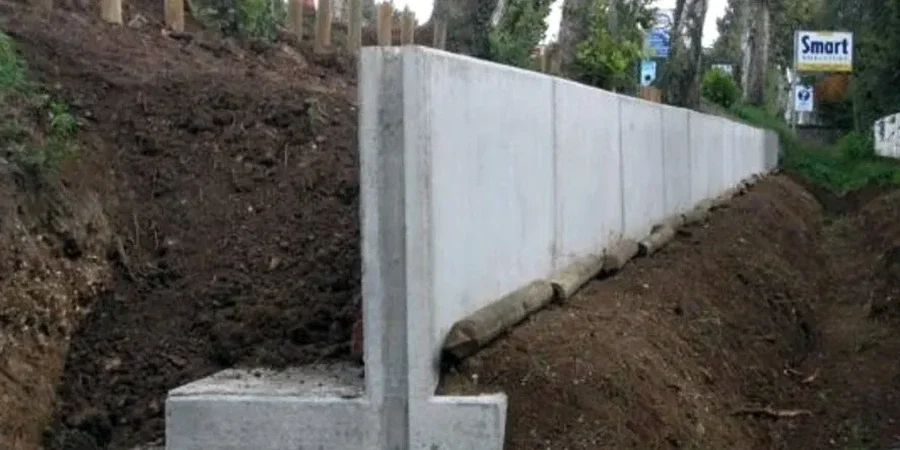
A commercial development on King Street Ouest encountered unexpected silty sand at just 2 meters during excavation. The original cantilever wall design was immediately deemed insufficient for the active pressure of Sherbrooke’s glacial deposits. This is a common scenario across the city’s rolling topography. The St. Francis River has carved deep valleys, leaving many properties with significant grade changes that demand more than a generic gravity block. Wall design here requires integrating frost protection at the 1.5-meter depth mandated by the NBCC, while managing the water pressures typical of the Estrie region. Before finalizing any foundation plan near a slope, we often recommend a test pit investigation to visually verify the stratigraphy, ensuring the wall’s heel sits on competent native material.
A retaining wall in Sherbrooke isn't just holding back soil; it's managing a dynamic system of frost, water, and steep terrain specific to the Estrie region.
Q&A
What is the typical cost for retaining wall design in Sherbrooke?
The engineering design fee for a retaining wall in Sherbrooke typically ranges from CA$1,520 to CA$4,990, depending on the wall height, complexity, and required site investigation. A simple 1.5-meter garden wall is at the lower end, while a structural wall supporting a driveway or building requires more detailed analysis and falls at the higher end.
Do I need a permit for a retaining wall in Sherbrooke?
Yes. The City of Sherbrooke requires a permit for any retaining wall over 1 meter in height, or any wall supporting a surcharge such as a parking area or building. The permit application must include stamped engineering drawings and a geotechnical report confirming the design assumptions.
How do you account for frost in the wall design?
We specify a foundation depth of at least 1.5 meters below final grade, which is the design frost penetration depth for Sherbrooke per the NBCC. The backfill must be free-draining granular material to prevent water retention. We also use a continuous drainage board to eliminate hydrostatic pressure, which is the main cause of frost-related wall distress.
What soil conditions in Sherbrooke affect retaining wall design?
Sherbrooke sits on glacial till and Champlain Sea sediments. The till is dense and provides good bearing, but the clay and silt deposits in the river valleys are sensitive to water. We always investigate the depth to competent material, as a wall founded on soft clay can knowledge excessive settlement and rotational failure. The presence of a high water table on slopes adds significant lateral pressure that must be managed with proper drainage.